
You would like to learn to play the saxophone but you are wondering: Is the saxophone hard to play? Do I need to sign up for saxophone lessons somewhere near me to learn to play the sax, or I can take them online?
The truth is the saxophone is not difficult to play but regardless of your previous skill level, to master playing this instrument you do need highly-knowledgeable and experienced instructions that can provide private, one on one saxophone lessons tailored to your learning style.
We at Mississauga Fine Arts Academy offer you the best chance to learn to play the saxophone from some of the best saxophone teachers in Ontario.
Regardless of your previous knowledge and saxophone playing skills, our teachers will support you, your learning style, special considerations, and will guide you every step of the way to help you master this instrument. It is of course faster and easier if you already have some experience or knowledge about any woodwind instrument, like the clarinet, but any self-disciplined and dedicated person can easily start from the very beginning and succeed.
Our music school offers beginner level saxophone lessons for anyone interested in this instrument and advanced level saxophone lessons for anyone with previous saxophone playing knowledge and skills.
We strive to match you with one of our talented instructors that will inspire you to practice and help you build your fundamental skills, which in return will guarantee your success.
Our highly accredited music teachers have received their music education from prestigious institutions such as The University of Toronto, Humber College, York University, Conservatory Berklee College of Music, Glenn Gould Professional School, McGill University Faculty of Music, to name a few.
Our music school offers a cutting-edge curriculum developed in collaboration with the Royal Conservatory of Music providing our students access to a nationally accredited program and giving them an excellent foundation in their music education. Our music teachers will work with you to prepare you for every level of your Royal Conservatory of Music examinations (RCM exams).
Our music students look forward to participating in their organized recitals and many music festivals and events across Ontario.
Our students come for in-person private saxophone lessons not only from Mississauga, but also from Brampton, Oakville, Milton, Etobicoke, and the Greater Toronto Area. This is a testimony to the quality of the music lessons provided at the Mississauga Fine Arts Academy and the satisfaction of our students.
For any of you interested in online saxophone lessons our music school provides the same quality private saxophone lessons online, anywhere in the world.
The saxophone (also referred to as the sax) is a wind instrument (aerophone) belonging to the subcategory of woodwind instruments. Even though most saxophones are made of metal (brass) the sax is classified as a woodwind instrument due to the way it produces its sound. The saxophone has a mouthpiece with a single oscillating reed traditionally made of wood. Nowadays the mouthpiece can be made of other materials like hard rubber, fiberglass, metal, or plastic. The size of the reed and the mouthpiece varies according to the size and type of the saxophone.
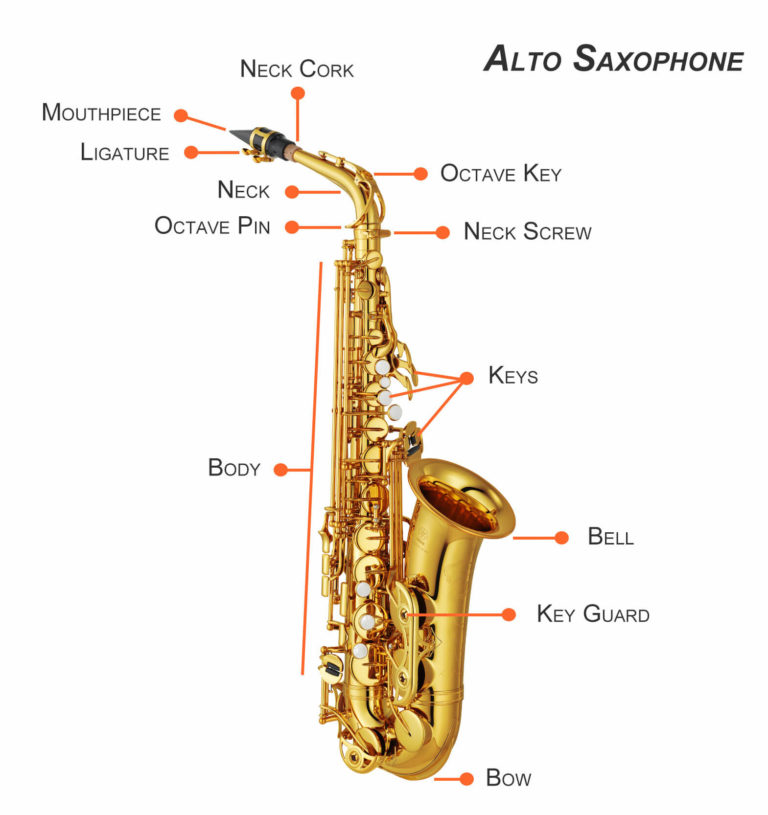
The body of the saxophone is a conical metal tube with around 24 openings (tone holes) controlled by padded keys and 2 small vent holes allowing for playing music in upper registers.
The soprano and sopranino saxophones are designed like a straight conical tube with a flared bell opposite the mouthpiece.
The alto and other larger saxophones have a detachable neck just above the highest tone hole. The set of curves near the bell is a distinctive feature of the saxophone.
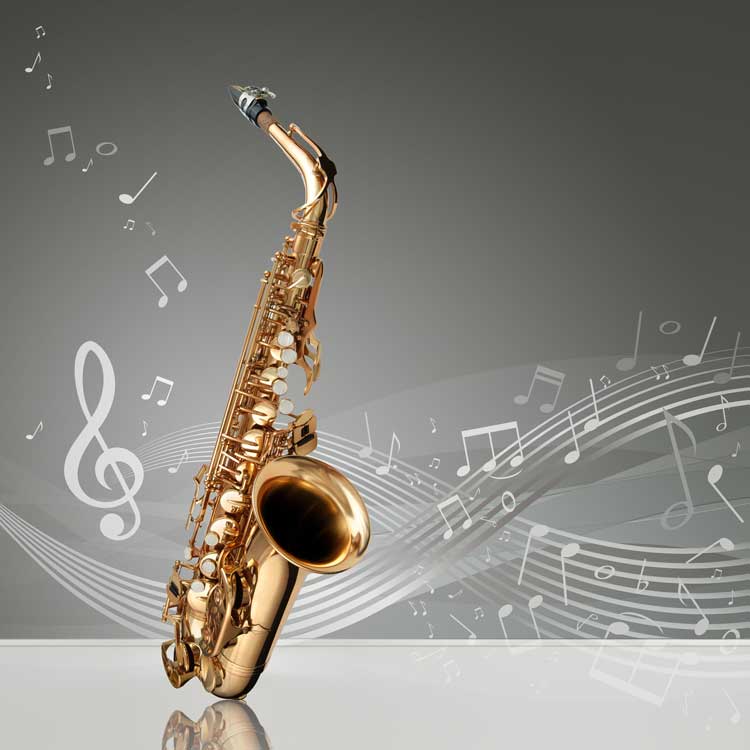
The most popular is the alto saxophone
The natural range of the saxophone
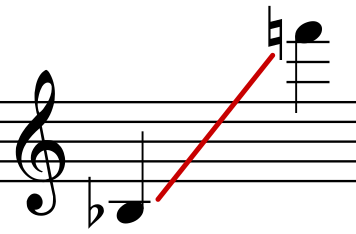
The saxophone is available in several different types allowing saxophone players to choose the one that best suits their needs, skill set, and personality. There are five most common saxophone types:
Other saxophone types:
At the outset of your studies, you could rent a saxophone until you are sure what type of saxophone you would like to play.
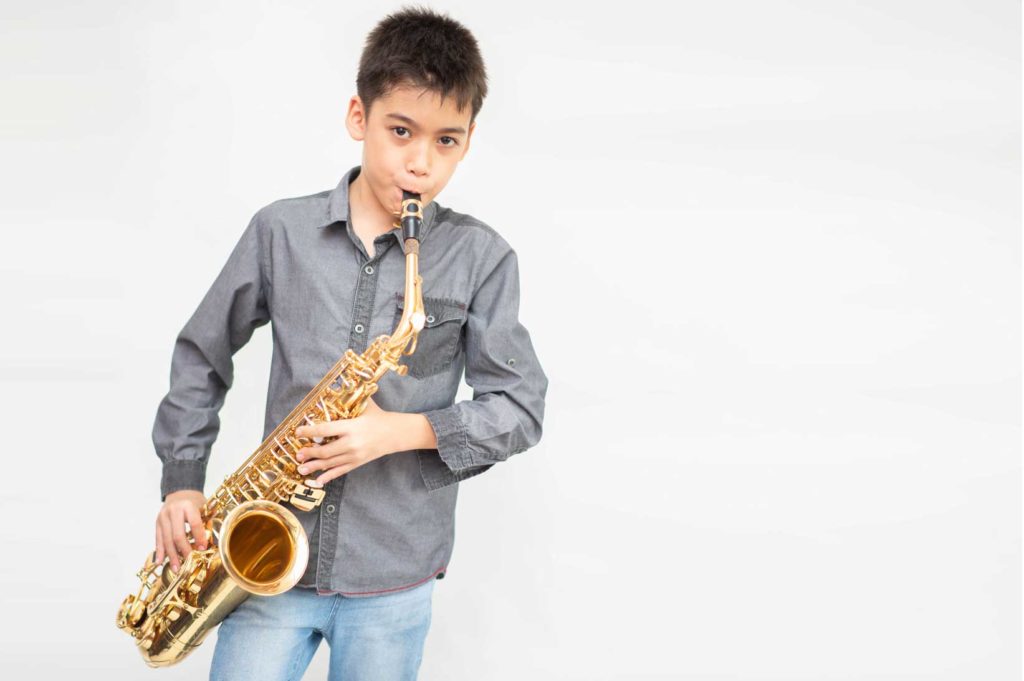
The most played and beginner-friendly saxophone is the alto saxophone. It gives the player the choice to play a variety of music genres and styles, like classical orchestral music, blues, jazz, and rock and roll music.
The first step in learning to play the saxophone is learning the proper positioning of the body, hands, and mouth
The saxophone can be played sitting or standing
Beginner saxophone players could get familiar with the instrument better if they are sitting down on a straight back chair when playing with both feet planted on the ground and the right leg supporting the instrument so it doesn’t bang against the chair
The player should sit up straight and avoid slouching
A neck strap will help hold the saxophone in position along with both hands on either side of the instrument
The right thumb rests under the lower thumb rest and the right-hand fingers wrap around the saxophone and rest on the bottom three keys
The lower thumb rest allows the player to move the saxophone and also hold it firmly while playing
The left thumb rests on the upper thumb rest, a key that is in the middle of the backside of the saxophone’s neck
The left-hand fingers wrap around and rest on the three keys on the upper part of the neck
The players bottom lip is drawn taut over the bottom teeth, the tip of the mouthpiece is placed over the bottom lip and the top teeth rest over the mouthpiece
The mouth should then create an airtight seal over the mouthpiece
The proper mouth position while playing the saxophone is called “embouchure”
The next step is to blow air into the saxophone, making adjustments to the mouth positioning until a clear sound is produced by the instrument
Pressing the top 3 keys with the left hand will play B, A, and G notes
Pressing the bottom 3 keys with the right hand will play F, D, and E notes
The first saxophone was invented by Antoine-Joseph “Adolphe” Sax, (hence the name saxophone), a Belgian instrument maker in Paris in 1846. The first saxophone was made of wood.
The saxophone in this image was made by Adolphie Sax in 1857 and was constructed from wood. Later he will switch the material from wood to brass.
Adolphie Sax was first a flutist and clarinetist. Prior to the invention of the saxophone, he worked on improving the bass clarinet and succeeded in extending its range. He continued experimenting with the bass clarinet by adding keys and improving its acoustics. Furthermore, he made changes to the mouthpiece of the clarinet leading to the invention of the single-reed mouthpiece and the saxophone. He made several types and sizes of saxophones in the 1840s and requested patents. He received a fifteen-year patent for the saxophone on the 28th of June,1846, which included fourteen different versions of the instrument. His saxophones were largely used by the French military bands.
When Adolphie Sax’s patent expired in 1866, other instrument makers continued the development and the improvement of the saxophone. This included adding extra keys and alternate fingerings to allow for playing certain passages with ease.
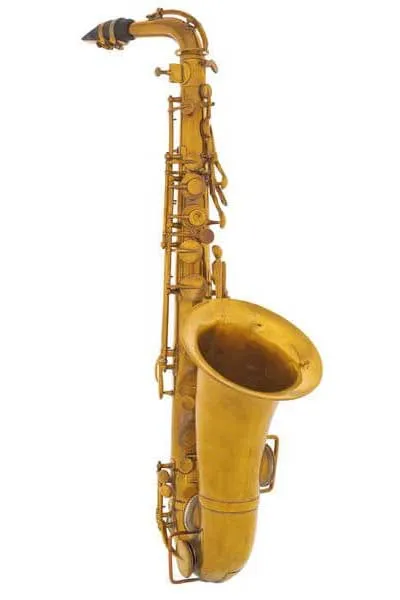
One notable advancement was the use of the left thumb to operate both tone holes using a single octave key, which is still common in today’s saxophones.
Other advances came in the 1930s and 1940s by the woodwind and brass instrument makers C.G. Conn, King Musical Instruments, and Henri Selmer Paris. The modern saxophone, as we know it today, is based on Selmer’s “Balanced Action” saxophone. This sax had balanced key work and distribution of weight. This was followed by the “Super Action” saxophone, which was launched in 1948, and the “Selmer Mark VI” that was refined, manufactured, and widely used in the golden age of jazz in the 1950s and 1960s. In the 1980s Selmer launched the first of the three “Super Action 80” series of saxophones.
The quest was to improve the saxophone’s acoustics, intonation, tone, and ergonomics.
The saxophone is used in many genres and styles of music, most notably in jazz music.
Well-known classical saxophone players include:
In this video, you can learn more about the influence of Mule and Rascher on the acceptance of the saxophone in classical music and saxophone quartet formations:
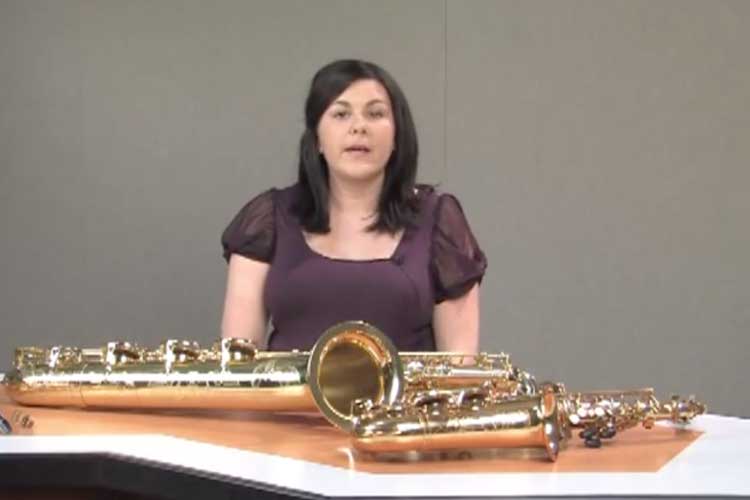
In the 20th and 21st centuries, many classical compositions included the saxophone. Its use includes opera, choral music, saxophone quartets, chamber music, orchestras, and even musical theatre.
Classical composers and compositions include:
1901
1934
The Concerto in E flat major for alto saxophone and string orchestra, Op.109
1958
Saxophone Concerto
1995
Concerto for Saxophone Quartet
2013
Concerto for Alto Saxophone and Orchestra
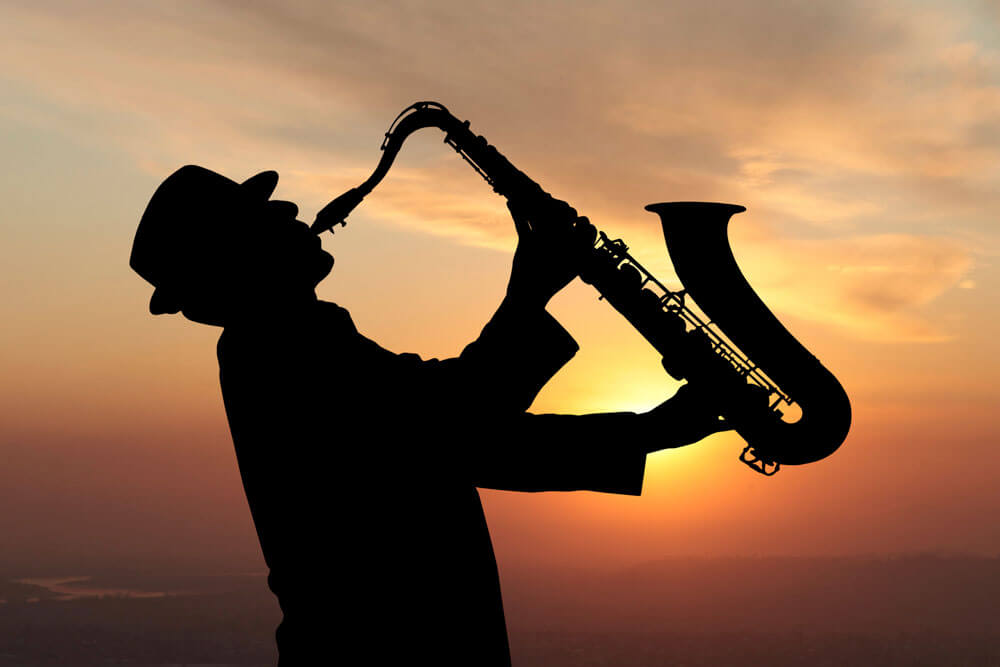
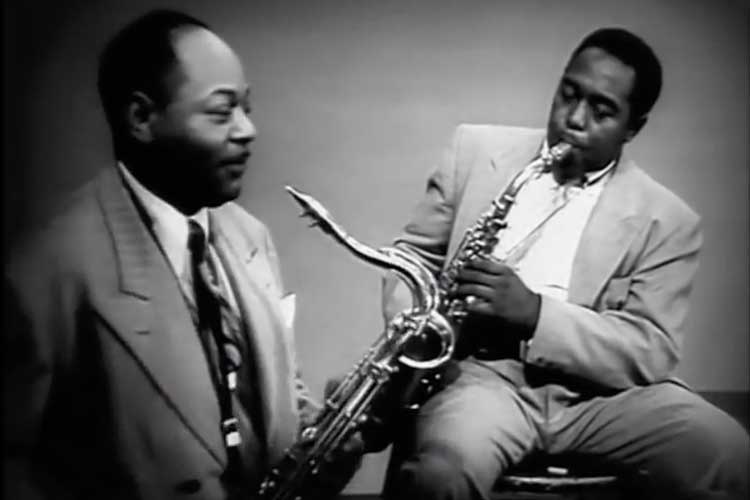
In this 1950s video, you can hear Charlie Parker and Coleman Hawkins playing jazz compositions on alto saxophone:
Learning to play any instrument has been proven to be beneficial in many ways. The saxophone is no exception. Some of the benefits include:
Improved cognitive function of the brain
Improved sensory and motor skills
Promotes discipline, patience, persistence, and discipline
Reduces stress and improves the player’s overall health and wellness
Promotes creativity and boosts confidence
Learning to play the saxophone involves breathing techniques that improve lung capacity

The sound produced when playing the saxophone can be adjusted and modified, in terms of pitch and volume among other things. With the help of many breathing techniques taught by a qualified instructor, the sax player can have better control over the quality of the sound produced by their saxophone. Many saxophone players not too long after starting to play the instrument are able to produce distinct tones and notes. The progression from beginner to intermediate level saxophone lessons is said to be faster than with other instruments.
FAQ
The academy notes that the saxophone is generally considered one of the more "beginner-friendly" instruments. Students often find they can produce distinct tones and notes relatively quickly. The progression from beginner to intermediate level is often faster on the saxophone compared to other woodwind or brass instruments.
The Alto Saxophone is the most recommended starting point for beginners. Its size and weight are manageable for most students, and it is versatile enough to play a variety of genres. The academy suggests renting a saxophone at the outset until the student is certain which type (Alto, Tenor, etc.) they prefer.
Yes. Students who have prior experience with the clarinet or flute often find it much easier to pick up the saxophone. The breathing techniques and fingering concepts transfer very well between these woodwind instruments, allowing for faster progress.
While the saxophone is an icon of Jazz and Blues, the teachers at the academy are also skilled in teaching Classical, Rock & Roll, and Pop. The curriculum is flexible, allowing students to explore the styles that inspire them most.
Yes. The academy’s curriculum is developed in collaboration with the Royal Conservatory of Music. The accredited teachers prepare students for all levels of RCM exams, ensuring they receive a nationally recognized music education.
Yes. The school provides private online saxophone lessons for students in Mississauga and the Greater Toronto Area, as well as internationally. These video-based lessons cover the same comprehensive material as the in-person classes.
Playing the saxophone requires specific breathing techniques that improve lung capacity and control. Additionally, it boosts cognitive function, improves motor skills, and serves as an excellent creative outlet that reduces stress.
The tuition rate for private saxophone lessons is $39.50 per 30-minute session. Lessons are scheduled weekly, available seven days a week, and require a one-time registration fee of $25 for new students.
We provide one on one private music classes, including RCM theory classes, voice lessons, and harmony lessons, in person at our convenient Mississauga location and online voice and harmony lessons.
Our current rate is $39.50 per 30-minute private music lesson.
Lessons are scheduled once a week and available seven days a week.
There is a one-time registration fee of $25.00.
No prior musical experience is required to start lessons.
Come, become a member of the Mississauga Fine Arts Academy music family! We will ignite your talent and help you discover and grow your ability to sing well and harmonize with ease.
We provide one on one private music classes for children and adults, including RCM theory classes, in person at our convenient Mississauga location and online saxophone lessons and other types of music lessons.
Our current rate is $37.50 per 30-minute private saxophone lesson.
Lessons are scheduled once a week and available seven days a week. There is a one-time registration fee of $25.00.
No prior musical experience is required to start lessons.
Learning to play the saxophone will bring joy to your life and boost your creativity. Come and become a member of the Mississauga Fine Arts Academy music family! We will ignite your talent within and help you become the best musician you can be.
Be inspired and celebrate the new year with music lessons at Mississauga Fine Arts Academy – Claim your FREE registration and 1st FREE class to save up to $62.50

You can text Mississauga Fine Arts Academy for information regarding our services. By texting Mississauga Fine Arts Academy, you agree to receive Conversational, Marketing and Lessons Related Updates and Promotional messages from Mississauga Fine Arts Academy. Reply STOP to opt-out; Reply HELP for support; Message & data rates may apply; Messaging frequency may vary. Visit www.mississaugafineartsacademy.com to see our privacy policy and www.mississaugafineartsacademy.com for our Terms of Service.
What is the Musical Ladder System?
At Mississauga Fine Arts Academy, we believe every student benefits from setting and achieving personalized goals. That’s why we use the Musical Ladder System—a unique, motivational program that celebrates students’ progress in music, just like karate belts or swimming levels.
With the Musical Ladder System®, each student receives a customized learning plan and is tested on their progress every 3 months for the first 18 months, every 6 months until their fifth year, and once a year after that. There are 18 levels in all, from Apprentice to Artist. Every level earns a certificate and a colourful wristband (students even get to choose between two designs), and major milestones, such as reaching Rock Star after one year, also earn a trophy.
This approach keeps students motivated and inspired, making learning music an exciting journey.