We Answer Your Questions

We Answer Your Questions
Registration is easy! Call or text the front desk at 905-276-0251 to find a schedule time that works best for your availability.
Scheduling is not available to view online. Once a day and time is confirmed, an email will be sent to you with digital paperwork to fill out within 24 hours. Alternatively, you can fill in paperwork in that 24 hour period at our office.
Our monthly tuition is based on lesson length and is charged as a flat monthly rate:
30-minute lesson (once per week): $158 per month
45-minute lesson (once per week): $237 per month
60-minute lesson (once per week): $316 per month
This works out to $39.50 per 30-minute segment.
For students enrolled in RCM Level 8 or above, lesson rates may be higher due to the advanced level of instruction required. For most students, reaching this level takes many years of study.
Music lessons are tax-exempt in Ontario, so no HST or additional tax is added to the lesson fees.
The academy operates on a simple month-to-month tuition structure. There are no long-term contracts. Payments are processed monthly via pre-authorized debit or credit card, making it convenient for parents without the need to remember due dates.
Yes, there is a one-time registration fee of $25 per student. This fee is only paid once when you first sign up and never again as long as you remain a student.
Absolutely! We always have office staff available at the front desk to assist our clients, answer questions, and provide support whenever you need help.
We are open Monday to Friday 9:00 a.m. to 9:00 p.m. Saturdays from 9:00 a.m. to 5:00 p.m. and Sundays from 11:00 a.m. to 4:00 p.m.
Most classes start around 3pm onwards. The last class times available are from 8:30 p.m. to 9 p.m.
Yes. We offer gift certificates for music lessons, which make great gifts for birthdays, holidays, and special occasions.
Gift certificates are available as part of our promotional packages offered throughout the year, including our popular Stocking Stuffer packages during the holiday season.
We do not require semester minimums for lessons. Every student here is on a month to month basis. If you are ready to start, you have nothing to lose as we only want students who truly want to be here and we will not commit you to a long term contract.
Every child is different, and readiness for lessons depends on a child’s individual abilities, attention span, and comfort level. We take this seriously and always consider parents’ guidance when deciding how to approach lessons and what learning format is most appropriate for their child.
For younger children, we also offer our Animal Adventure program, where children can start as early as age 3. These are one-on-one private lessons, so the teacher’s full attention is focused on your child. The program is designed as a playful, engaging introduction to music, instruments, and basic musical concepts in a fun, low-pressure environment. We can link the Animal Adventure program here as well.
We have many teachers that pair well with younger students, students with a lot of energy, and students needing extra support such as students with autism, ADHD, and more. Some of our teachers are experienced with ECE and/or music therapy. If you have any specific requests for teachers in these fields please bring them up to us while we are looking into scheduling.
You are free to stop lessons at any time with no penalty. We simply require that you notify the office by the 15th of your last month. For example, if you wish to stop lessons at the end of December, you must submit a withdrawal form by November 15th.
We offer two free recitals per year at the Living Arts Centre in downtown Mississauga. As well, many students participate in outside exams such as RCM and festivals such as the Peel Music Festival and the Kiwanis Music Festival.
Absolutely. Our instructors are highly qualified, with many holding degrees from prestigious institutions like the University of Toronto, Humber College, and the Royal Conservatory of Music. Additionally, every teacher passes a strict background check for your peace of mind.
Yes, if you have any requests for instructors please let us know while we are looking into scheduling.
We are able to make changes moving forward at any time, however we do require 24 hours notice to make a change. We are not able to change lessons week to week.
We have teachers that speak many different languages, such as: Mandarin, Cantonese, Russian, Ukrainian, Spanish, Hindi, Urdu, Punjabi, Tamil, Korean, French, Tagalog, Croatian, Portuguese, and Arabic. We cannot guarantee a teacher that will speak a specific language other than English however we can always make note of any requests and look into options that may work best for you. Of course, all of our teachers speak English.
We have helped to prepare students for all levels of RCM from prep to ARCT on all major instruments: Violin, Voice, Piano, Guitar and Cello. We encourage families to speak with the teacher directly about specific details for RCM. As well, we offer the Musical Ladder System for all students to participate in a more personalized testing system based on time frame instead of specific levels.
Yes. We have an "Open Door Policy." Parents are welcome to sit in the lesson room to observe, or they can relax in our comfortable lobby with free Wi-Fi while their child learns.
We offer a very flexible make-up policy and understand that schedules can change. If you’re unable to attend a scheduled lesson, you have four options:
Students may either withdraw from classes if leaving for an extended period of time, or can continue paying for their spot and book group make up classes or request pre-recorded lessons for missed lessons.
We do not hold unpaid spots while students are absent. If you withdraw from lessons, we cannot guarantee the same day, time, or teacher when you return.
There is a parking lot in front of the academy with free parking.
Yes! We are open 7 days a week. We offer lessons on both Saturdays and Sundays to accommodate busy work and school schedules.
Yes, we offer free trial lessons during our Bring a Friend Week, which we run on a quarterly basis. During this special event, students can try any instrument in a fun, low-pressure setting and get a feel for how lessons work.
Outside of Bring a Friend Week, our standard practice is to offer a trial month rather than a single trial lesson. From our experience, one lesson alone is usually not enough, especially for beginners, to truly understand whether a student enjoys lessons or connects with the instrument and teacher.
Our trial month includes four 30-minute lessons for $158. This allows students time to settle in and experience real learning. If you decide not to continue after the trial month, there is no further commitment required.
Many beginner students start their musical journey with piano, as it provides a strong foundation in music reading and coordination. That said, the best instrument to start with often depends on the individual child. If a student is excited about a particular instrument, that enthusiasm usually makes it the right place to begin.
For instruments with a stronger physical component, such as guitar and violin, we generally recommend starting around age 7, when children have developed sufficient hand size and coordination. For wind instruments that require greater lung capacity, such as the trumpet and flute, we typically recommend starting around age 10.
For young beginners ages 3–5, the most popular starting options are piano, singing/vocal, and drums. We also offer our Animal Adventure program, an introductory-to-music program designed specifically for young children, providing a playful and engaging way to explore music before moving on to a specific instrument.
For piano, drums, and vocal lessons we will have instruments and materials available at the school for usage. For all other instruments, we do require students to have their own instruments. If you are looking for instrument rentals and purchases, we always recommend our friends at MusicM.
Their address is 7035 Maxwell Road Unit 8 and their phone number is 416-558-1088. For more information check out their website at https://www.musicm.ca/. We do have a limited amount of guitars, ukuleles, and violins for the first lesson if a student is waiting for an instrument to come in.
Yes! We offer an ongoing referral program throughout the year. If you refer a friend or family member to us and they sign up for lessons:
There is no limit to how many people you can refer. Each successful referral gives you another entry into the quarterly draw—the more people you refer, the more chances you have to win.
Prizes vary from contest to contest, and many of our students have been lucky to win items such as Apple AirPods, Bluetooth speakers, karaoke stations, tablets, and more.
It is always better to learn guitar with an instructor. Life interaction and the teacher's example make the process more enjoyable and productive. A qualified instructor will inspire, motivate, and keep you accountable. This type of experience cannot be gained by self-education.
The speed of learning to play the guitar depends on several factors:
• Individual abilities and capabilities of the students
• Qualification of the instructor
• Frequency of classes
• The intensity of in-home practice
• Your burning desire to learn guitar (most crucial factor)
You definitely can. Thousands of books, self-teaching methods, and videos are available nowadays to learn guitar, but none can replace one-on-one life interaction.
Books are written by professional musicians and created to develop a structured approach to studying guitar. They contain fundamental knowledge about an instrument. They help obtain technical skills and teach how to read guitar music, which is a critical component in learning guitar. It will be essential to have a book for the class, especially for beginners.
Online classes are a great alternative to in-person classes for those who choose to study from home or far from their favourite teacher. Nowadays, technology allows learning guitar even if your instructor is thousands of kilometers away. It is excellent to do online classes, but they will never replace live interaction with the class teacher.
Practicing regularly is more important than the time spent practicing at any given time. It is better to practice 15-25 min every day than 2 hours once a week. Learning any musical instrument is to obtain specific motor and muscle memory skills. Therefore, our muscles need to have more time to be trained. The more we make our muscles work, the faster we remember the task. As a result, we learn more quickly.
It is a great idea to set the expectations for your first class. Always talk to your teacher and express your actual needs, as they can be very different for each student and based on various factors. A 5-year-old child has a very different need than a 25-year-old who picked up a guitar for the first time. Setting the course for the future and letting your teacher know what you want to learn will save time and frustration.
Piano lessons help children develop good musical practices, improve concentration, and build self-esteem. Playing piano teaches them to understand rhythm, timing, and proper body position. Students can improve their vocal, speaking, and writing skills through private piano lessons.
Students who take private piano lessons will learn how to sing along with song lyrics, speak fluently, and compose original compositions.
If you would like to nurture your child's creativity, add a little structure to their lives, and have a lot of fun, then yes, it's highly recommended that children take piano lessons.
The best way to learn to read music is to take piano lessons at a local music school. Music schools' piano teachers teach students everything from basic theory to advanced techniques like sight reading. Students can also participate in recitals and competitions to showcase their talents.
Usually, around 3-4 children develop an interest in music. The sooner a child starts, the sooner they begin a lifelong journey.
No! Keeping things simple is the easiest and fastest way to learn.
Absolutely. Keyboards are an instrument in their own right and think of it as learning keyboards instead of learning piano.
The piano is about exploring the music you love. Find a teacher who encourages your child's musical interests. If your children are having a good time while learning to play, it's a great lesson.
Yes, as most of the work is done by you and at home. However, your progress can be slow and frustrating without a good teacher who gives you guidance and direction.
Lessons can last from a few months to a few decades. It all depends on the student's interest and desired accomplishment level.
Not exactly, but some models do have good sound replication. However, note that keyboards are instruments with many features that cannot be replicated on an acoustic piano.
You can try learning piano independently, but it always helps to have an experienced guide by your side. Try asking a YouTube video for a better explanation, and you'll quickly discover the answer.
Professional voice lessons help you understand the power of your voice. They teach you how to control it better using breathing techniques necessary to sing correctly and safely.
You can start taking voice lessons at any age, young or old. However, starting young will allow you'll benefit from great vocal habits from the get-go!
Teaching yourself to sing is possible, but specific techniques and styles of singing require physical awareness and attention to vowel placement, which is easier with a teacher or another set of trained eyes and ears that can demonstrate proper positioning.
Learning to sing does not have an end date. Professional musicians are constantly growing and educating themselves on new techniques, keeping updated at all times. So, no specific number of "required" lessons to become a singer exists.
Yes! Everyone can learn how to sing!
Online vocal lessons are sometimes even more beneficial as the teacher can see the student's vowel placement and positioning. They are equivalent to in-person and sometimes provide greater attention to technique.
A vocal coach is more than just a teacher but a guide to understanding your voice and body. They can help you realize your instrument to its full potential.
A vocal coach and a voice teacher are the same.
Select a vocal coach/teacher that resonates with you and your voice the best — someone who understands your music taste and preferences as a person and respects your learning pace.
Yes, almost all professional singers have vocal coaches.
A voice lesson can consist of different structures depending on the teacher and the lesson time. Typical voice lessons include pre-warm-ups, ear training, technique building, song performance, and showmanship evaluations.
The best time to start voice lessons is anytime. Young or old, our voices are always with us. With guidance, anyone ages four and up can begin their voice journey.
Vocal harmony is a style of vocal music where notes are simultaneously sung in a homophonic texture.
Harmony provides colour and enhances the main melody.
A learning musician can study the multiple harmonic textures available for a melody.
Yes! A trained and professional lead singer will be able to understand the specific timbres of vocal harmony and should be able to blend properly as a background singer as well as a lead.
Although theoretical knowledge will enhance your ability to write and perform accurate and effective vocal harmony, you do not have to learn music theory.
A vocal melody, or vocal line, is a melodic sequence written for the human voice. The vocal melody is usually the focal point of the entire musical composition.
Jazz harmony is notable for using seventh chords as the basic harmonic unit more often than triads, as in classical music.
One site you can reference is called Teoria, and it can be found here: https://www.teoria.com/index.php
There is no best age to start taking drum lessons. You’re never too early or too late to the craft! Whenever you develop a desire for it, you should go for it.
Drum lessons are super beneficial to better understanding the context of what you’re playing. You can get a better and deeper appreciation of the craft this way.
You can take as many drum lessons as you want. There's no set amount you'll be good after as it's constant development. Once you feel comfortable enough with a foundation to create your own voice through drumming, you can either keep learning or go solo! It's preferred you do both!
Yes! You can learn by ear, but you won't develop a greater understanding of the craft. You become locked into a surface-level approach to drums, while drum lessons can take your craft to another level.
Even though you can teach yourself to play drums at home, taking professional drum lessons would help you learn it better and faster.
Several research papers show that drummers generally have more neural links in the brain and better understand independence due to having to individually coordinate all four different limbs to do different things independently from each other.
Professional drummers, those who make a living by playing drums for bands and artists, practice upwards of eight hours a day! A more reasonable amount is 45-60 min a day to keep things fresh and at the forefront of your mind.
If you can count to four, you can play the drums. Sure, there are more complex and advanced techniques, but it's not difficult to play along with your favourite pop/rock songs.
A good drum teacher is willing to adapt their teaching style to fit the student, not the other way around. Someone who keeps the student engaged and wanting to continue playing.
Drum lessons are always a lot of fun. Playing your favourite songs and understanding WHY you like them is just pure bliss!
It all depends on where you are starting, how serious you are about your lessons, how much you practice, and your goals. On average, it will take about a year to go over the basics of the Suzuki book or RCM violin technique before becoming comfortable with reading music.
If you want to achieve a goal and learn a skill, you have to budget for it. Lesson prices for any instrument are roughly the same. Teachers and school program coordinators work very hard to ensure they provide extraordinary value to their students; thus, they need to be rewarded for it.
If the student is a small child, you must ensure the instrument is the correct size for that child. The best way to tell is to extend your left arm to ensure you can grab around the scroll when you hold it.
Violin lessons can vary. It all depends on where you take classes and who teaches it; if you do it privately outside a school, or at a private school, or public school program.
No it's not, as long you want to learn and practice diligently.
Beginners should play as much as they possibly can! At the early stage of learning the instrument, you need to spend a lot of time building muscle – it's like a workout. The more you do it, the sooner you can achieve your goals. For instance, if a student is five years old, it's recommended to practice for about 20-30 minutes daily. It is better to do a little each day than a lot but skip days. Mature students usually practice one to two hours daily to stay on top of their skills and complete their examinations.
Yes, a four-year-old can learn to play! It all depends if the child is mature enough to listen to instructions and get motivated to play. We all grow at different rates, so for some people, three years old is a good start, while others might have to wait until they are seven or nine.
Learning both a piano and violin is helpful. The two complement each other well and help the student develop a good ear for music, sight-reading skills, and musicality.
Yes, you can, but “self-teaching” depends on how high your standards are. Playing notes is one thing, but playing the notes with quality - sound production and profound musical interpretation is a different level of playing the cello. A string instrument will expose flaws more quickly to the audience than a piano or a guitar.
Most cello teachers recommend the age of six or seven as the best age to start cello lessons.
Yes definitely. By learning cello online, you can learn at your convenience and not worry about taking the subway or driving to your cello lessons. With an internet connection, you can access an online library of lessons regardless of where you may be.
It is never too late to start a musical instrument.
To properly hold your cello bow, your four fingers must drop naturally into place, and your thumb to go half on half of the Nook. Then you angle your fingers inward to apply pressure making those knuckles turn.
Student cellos are the lowest-cost, averaging around $300-$400, while the highest-cost cellos, professional level, can be well over $10,000.
Cellos are measured by the length of the back, from the full-sized cello of 30 inches or more intended for adults over five feet tall to 1/8 cellos designed for children between four and six years old. Be aware that different cello manufacturers make cello sizes at slightly different lengths, but they will fall within a few inches of each other.
The most important thing is comfort and practicality; you'll likely be more comfortable with the smaller instrument if you are between two different sizes.
Yes, it is possible to teach yourself to play bass guitar. However, having a good instructor can fast-track your progression. A bass teacher will identify weaknesses or improper techniques and broaden your student's musical taste.
The pursuit of musical achievement is endless, and every student's goal is different. Still, in under a year, a dedicated student should be reading notation and have essential fretboard awareness and various techniques (pick, slap and pop, pizzicato).
The best online bass guitar lessons are the ones that are consistent and fun. Bass guitar instructors who introduce new material regularly, motivate students to succeed, and hold students accountable are the best.
The basics are easy to pick up. As with almost every instrument, there is a wealth of material to digest and study ranging in difficulty to keep any level player engaged and progressing musically.
You can practice playing the bass guitar unplugged in a quiet room. However, playing it through an amp or with headphones is better so that you don't hit the strings too hard, strain your hands, and possibly cause an injury.
Although bass and guitar look similar, they are two very different instruments with different functions. There is some overlap between the two instruments, like the left-hand technique, but it doesn't matter which one you learn first.
Yes, there are different-sized bass guitars that will make playing and learning bass a breeze; There are full-sized basses for adults to miniature ukulele basses for smaller hands.
The fundamentals of playing the flute are easy to learn. Like any instrument, the more you play the instrument and explore challenging repertoires, the more the learning curve increases.
Yes. You can experiment with playing the flute on your own. However, seeking instruction (private or in-class lessons) is highly recommended as soon as possible. A flute instructor can teach proper practice techniques, aid study/repertoire selections, and guide your performance practices.
There are many student flute models, and they usually have covered tone holes and do not have a B-foot. The next-up student model has open tone holes and a B-foot. Flutes made of nickel and have closed tone holes (the least expensive) have a poorer sound quality than those with open tone holes. Remember that the flute material and construction also matter (silver, platinum, or gold).
Playing flute does not improve your lungs, per se, but playing flute will improve your breath control because the proper flute technique engages the diaphragm. The more you practice, the better your breath control will be.
The more difficult instrument is the one you don't practice.
Anyone can play the flute!
Music theory is a system for helping students to comprehend and organize sounds of a particular aesthetic.
Music theory is inevitable and valuable, even at the most basic, fundamental level.
Music theory is something you learn alongside performance or any aspect of music. Ideally, one never stops learning about music theory.
The RCM Level 1 Theory book is a good start. It is advisable to start with the most general topics and then work toward more specific theories.
There are many free resources available to learn music theory. To start, Wikipedia has collected several music theory articles into an elementary book (https://en.wikipedia.org/wiki/Book:Music_Theory).
Alternatively, the Youtube channel "Music Matters" has assembled a playlist of various music theory topics (https://www.youtube.com/playlist?list=PL5j5H06QkhxE0RK-Ormp3zgf5SGJ28zsj).
Beyond the internet, a local library is an excellent place to check out textbooks and other non-fiction books related to music theory.
The difficulty is proportional to one's prior knowledge and starting point. For example, starting with an advanced topic can be pretty difficult, but starting from the beginning is not.
Yes, all musicians know at least a bit of music theory.
Animal Adventures is a private, one-on-one music program for children aged 3 to 5. Unlike group classes, it provides your child with the teacher’s full attention, allowing them to learn at their own pace.
Music theory is inevitable and valuable, even at the most basic, fundamental level.
We keep toddlers engaged by breaking the 30-minute lesson into three fun, 10-minute activities:
Table Time: Working on colorful books and stickers.
Rug Time: Playing active music games on the floor.
Stage Time: Getting hands-on practice with real instruments. This fast pace is perfect for young children in the Peel Region.
Your child will get to explore 10 different instruments. Throughout the program, they will see, hear, and touch the piano, drums, guitar, violin, cello, flute, clarinet, saxophone, trumpet, and voice.
Your child will learn real music skills. While we use fun stories and animal characters, by the end of the program, your child will know how to read simple notes, recognize music symbols, and clap to different beats.
Once your child completes all 10 levels and collects their reward medals, they are fully prepared to start regular private lessons. Because they already know the basics of music, they can easily transition into learning the piano, violin, or guitar at our academy.
The difficulty is proportional to one's prior knowledge and starting point. For example, starting with an advanced topic can be pretty difficult, but starting from the beginning is not.
Yes, all musicians know at least a bit of music theory.
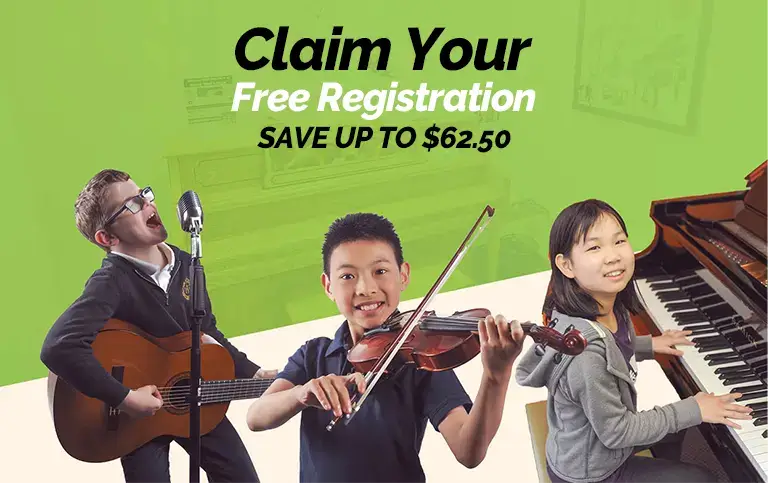
Be inspired and celebrate the new year with music lessons at Mississauga Fine Arts Academy – Claim your FREE registration and 1st FREE class to save up to $62.50
You can text Mississauga Fine Arts Academy for information regarding our services. By texting Mississauga Fine Arts Academy, you agree to receive Conversational, Marketing and Lessons Related Updates and Promotional messages from Mississauga Fine Arts Academy. Reply STOP to opt-out; Reply HELP for support; Message & data rates may apply; Messaging frequency may vary. Visit www.mississaugafineartsacademy.com to see our privacy policy and www.mississaugafineartsacademy.com for our Terms of Service.
What is the Musical Ladder System?
At Mississauga Fine Arts Academy, we believe every student benefits from setting and achieving personalized goals. That’s why we use the Musical Ladder System—a unique, motivational program that celebrates students’ progress in music, just like karate belts or swimming levels.
With the Musical Ladder System®, each student receives a customized learning plan and is tested on their progress every 3 months for the first 18 months, every 6 months until their fifth year, and once a year after that. There are 18 levels in all, from Apprentice to Artist. Every level earns a certificate and a colourful wristband (students even get to choose between two designs), and major milestones, such as reaching Rock Star after one year, also earn a trophy.
This approach keeps students motivated and inspired, making learning music an exciting journey.